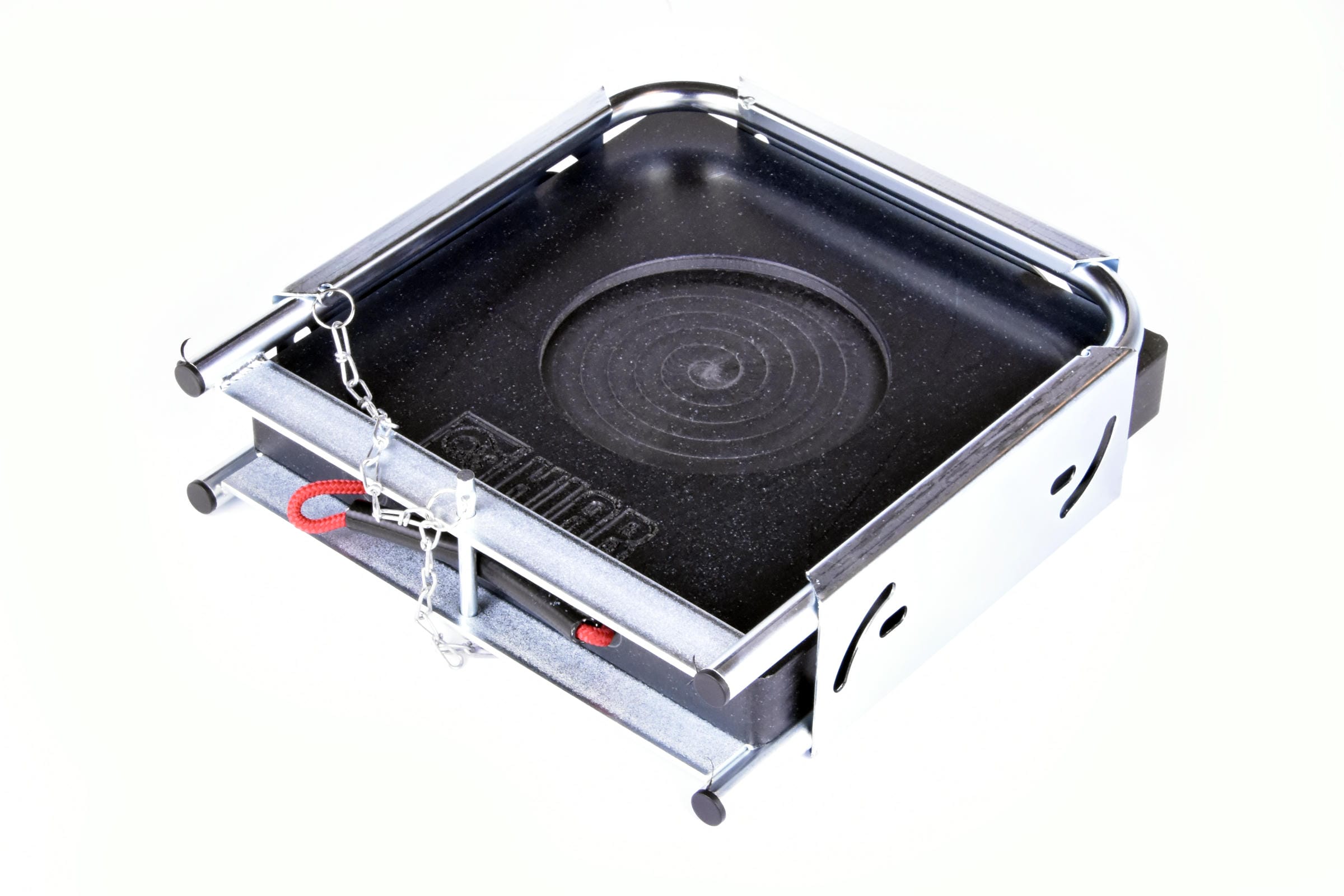
Stabilizer pads, often also called supports or stabilizer mats, are an important part of the equipment for the safe setup of hydraulic cranes, truck-mounted cranes, and hydraulic platforms/baskets for working at height.
Their task is simple but extremely important – to distribute the stabilizer force over a larger ground area and provide a more reliable base for the machine to work on.
Without a suitable pad, the stabilizer foot transfers a large load onto a relatively small area. On asphalt, soil, gravel, grass, or uneven terrain, this can lead to sinking or shifting of the support, and therefore to a change in vehicle stability during operation.
That is why a stabilizer pad is not just an accessory you carry on the vehicle.
It is also important to choose the right pad in accordance with the type and kind of crane/platform you use.
Why are stabilizer pads used?
The larger the support area, the more the load is spread over a larger ground area. This is exactly why pads help reduce the local pressure that the stabilizer transfers to the ground.
Their use is especially important when working on soil, gravel, grassy surfaces, asphalt, and other surfaces whose load-bearing capacity may be limited or uneven.
It is important, however, to understand that a pad by itself cannot make unsuitable terrain safe. Before setting up the crane, the operator must assess the ground, the vehicle's position, and the working conditions, and use the equipment in accordance with the manufacturer's instructions.
Pads are also used when you want to prevent damage to the surface under the stabilizer foot, when working indoors, in halls, on concrete surfaces, or even on lawns …
What types of pads are there?
Stabilizer pads differ primarily in dimensions, shape, thickness, material, and permissible load.
Square and rectangular pads are most commonly used, because they provide a large contact area and are easy to store on the vehicle. Depending on the application, pads of other shapes and dimensions are also available.
Smaller and lighter pads are practical for equipment with lower loads and simpler everyday handling, while for heavier cranes and more demanding working conditions, larger, thicker pads with a greater support area and an appropriate rated load capacity are used.
Pads may have handles or openings for easier carrying, and suitable boxes and carriers are also available that allow them to be stored properly on the vehicle and always be accessible to the operator.
Pad materials
Modern stabilizer pads are often made of high-strength synthetic materials, although other designs can also be found in practice.
A quality material should be suited to high pressures and field working conditions, but also practical enough for everyday handling.
That is why, when buying, you should not look only at the outer dimensions of the pad. Material, construction, thickness, rated load, and the recommended use of the specific product also matter.
How to choose the right pad?
There is no single size that suits every crane and every terrain.
When choosing, you should consider:
- the maximum load that the stabilizer can transfer to the ground,
- the size of the stabilizer foot itself,
- the required support area,
- the load-bearing capacity and condition of the ground,
- the weight and configuration of the vehicle and the truck-mounted equipment,
- the conditions in which the crane or platform will operate,
- the equipment manufacturer's and the pad manufacturer's specifications and recommendations.
The basic principle is simple: a larger pad area allows the force to be distributed over a larger ground area, but the appropriate size must be determined according to the specific load and working conditions.
That is why a pad should not be chosen solely on the principle of “the stabilizer foot can fit on it”.
Pads for cranes and platforms are not important only on soil
A common mistake is the assumption that pads are needed only when working on mud or soft ground.
Even a surface that looks solid at first glance can have limitations. Asphalt can deform under concentrated load, there may be layers of different load-bearing capacity beneath paving blocks, and construction sites may contain manholes, channels, utilities, or previously excavated parts of the ground.
That is why, before any work, you must assess not only the surface we can see, but also the ground's ability to bear the load of the stabilizer.
The pad is small compared to the crane/platform. Its role is not.
The stability of a hydraulic crane or hydraulic platform begins before the first load is lifted – with the right choice of work location, proper positioning of the vehicle and stabilizers, and the use of suitable pads.
The Tehnika Hidraulike range includes stabilizer pads and supports in various sizes and designs, as well as boxes and carriers for storing them on the vehicle.
When choosing the right pad, we can help you select the appropriate solution according to the type of equipment, the stabilizers, and the working conditions.
Don't choose a pad by size alone. Choose it by the job it needs to do safely.