
Registration and Certification of Modified Vehicles
Having trouble registering modified or upgraded vehicles?
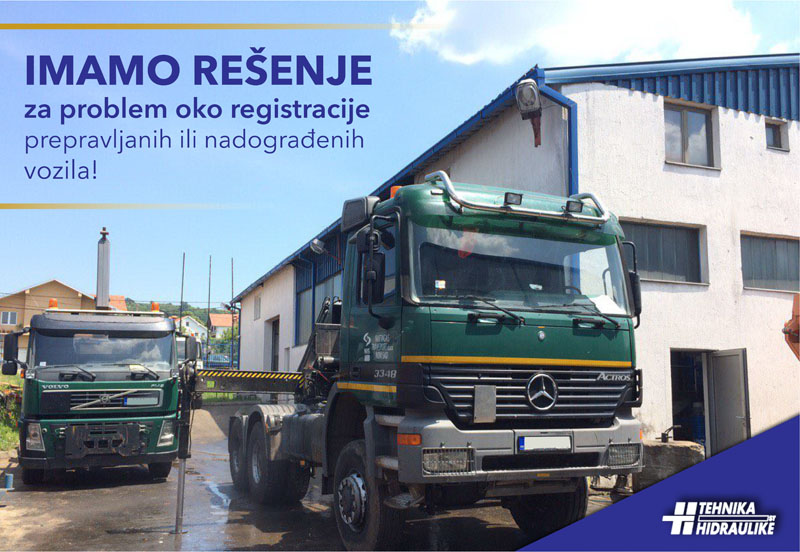
Over the past year, Tehnika hidraulike st has received many calls and requests for help with registering: modified vehicles, used vehicles, custom-built trailers, and vehicles with special truck-mounted equipment (an aerial platform, a truck-mounted crane ..).
Bearing in mind our clients' requests and the help they need to successfully register their vehicles, Tehnika hidraulike st has decided to write a short guide that would ease or simplify the procedures and documentation required for successful vehicle registration.
To begin with, we have singled out the meaning of the most important terms and abbreviations from the RULEBOOK ON VEHICLE TESTING (Official Gazette of RS Nos. 8/12, 13/13, 31/13, 114/13, 40/14) to make it easier for the client to understand the subject matter:
- testing is a set of activities for verifying the conformity of vehicles, equipment and parts with the relevant manufacturer's documentation, regulations and standards, which requires the use of test equipment;
- inspection is a form of testing for which the use of test equipment is not required;
- homologation of vehicles, equipment and vehicle parts is the procedure of type verification and of their conformity with the requirements of the relevant UN regulations on the homologation of vehicles, equipment and vehicle parts, or the relevant EU regulations, the issuing of the relevant prescribed documents and the monitoring of production to ensure conformity with the homologated type;
- vehicle modification is a change to the vehicle's structural characteristics that alters the purpose or type of the vehicle, or its declared technical characteristics, or the declared characteristics of the vehicle's devices and assemblies;
- a used vehicle is a vehicle that has been registered and at least 6 months have passed since its first registration; for an agricultural or forestry tractor, at least six months have passed since its first registration and it has at least 50 operating hours, or it is an unregistered tractor with at least 100 operating hours;
- an individually manufactured new vehicle is a motor vehicle or trailer consisting of a body or chassis that is newly manufactured in the sense that, as such, it does not exist in the production program of any vehicle manufacturer, i.e. it was made as an entirely new product that, by category, make and type, does not exist in the production program of any existing registered manufacturer of motor vehicles and trailers, while the final product – the new vehicle – can, after testing, be classified into a particular vehicle category in accordance with the regulation on the classification of motor vehicles and trailers, and as such can be assigned the make and type of the manufacturer that produced it;
- vehicle assembly is the production of a vehicle by assembling it from body elements – a frame previously produced by a registered vehicle manufacturer (with the vehicle identification number stamped in) – and powertrain elements (in the case of a motor vehicle) likewise already produced by a registered powertrain manufacturer (with the engine number stamped in), with the installation of devices and equipment belonging to the selected chassis or body;
- a completed vehicle comprises a series-produced and homologated chassis – an incomplete vehicle – that is not finally completed (fitted with a body or equipment) by the chassis manufacturer;
- a modified vehicle is any vehicle on which changes have been made to the vehicle's structural characteristics that alter the purpose or type of the vehicle, or its declared technical characteristics, or the declared characteristics of the vehicle's devices and assemblies, as well as other types of modifications that may be carried out, the testing of which is likewise subject to this rulebook.
Testing, i.e. inspection, of motor vehicles and trailers for the purpose of issuing a vehicle testing certificate, as well as keeping records of the tests performed and the certificates and confirmations issued, is organized and carried out by the Road Traffic Safety Agency.
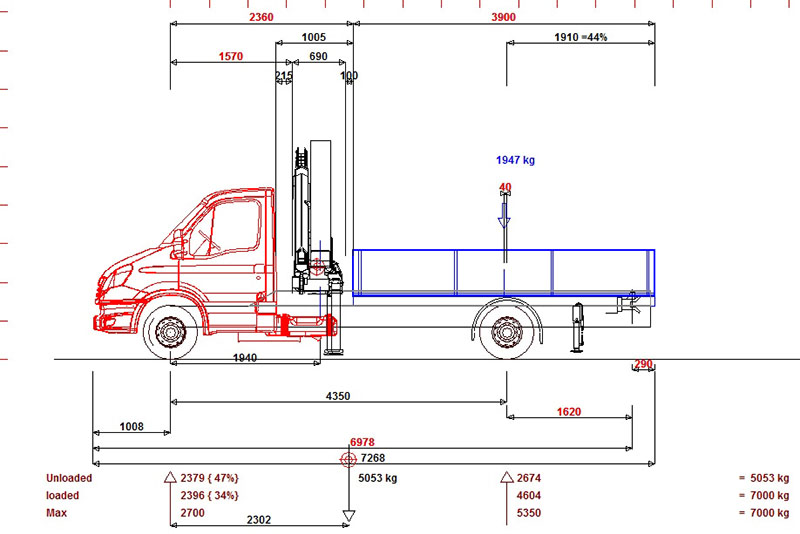
The issuing of certificates by the Road Traffic Safety Agency applies to the testing of motor vehicles and trailers:
- that are individually manufactured and for which no certificate of conformity with the homologation regulations has been issued;
- that are being modified;
- that are imported as used;
- for which, during a technical inspection or in another way, a discrepancy is found between the data entered in the vehicle registration document and the data in the Vehicle Database.
Vehicle testing consists of: vehicle identification, inspection of the vehicle and its equipment and parts, determination of the vehicle's technical characteristics that require measurements, review of documentation, calculation of technical parameters, case processing and preparation of the vehicle test report.
Vehicle inspection consists of: vehicle identification, inspection of the vehicle and its equipment and parts, verification of the vehicle's technical characteristics that do not require measurements, review of documentation, calculation of technical parameters, case processing and preparation of the vehicle test report.
A preventive inspection of your vehicle can be carried out on the premises of Tehnika hidraulike st at Beogradska 141a, Vrčin, in order to determine its condition and any non-conformities with the Rulebook on Vehicle Registration and the Rulebook on the Classification of Motor Vehicles and Trailers and the Technical Conditions for Road Traffic. After that, Tehnika hidraulike st submits a report with a request for approval of the modifications, on the authorization of the vehicle owner.
The request for approval of a vehicle modification is submitted together with the vehicle modification documentation and other technical documentation, in three copies.
After reviewing the submitted technical documentation, the Agency decides on the request for approval of the vehicle modification, in accordance with the law.
A vehicle modification is approved by the Agency, or an authorized legal entity, certifying every page of the technical documentation and returning two copies to the applicant.
For each vehicle test performed, the Agency, or an authorized legal entity, draws up a test report, which may be positive or negative.
On the basis of a positive test report confirming the vehicle's technical roadworthiness by a company authorized to carry out vehicle technical inspections, the Agency issues the applicant two copies of the certificate, in accordance with the law. The certificate is valid until the vehicle's structural characteristics are changed.
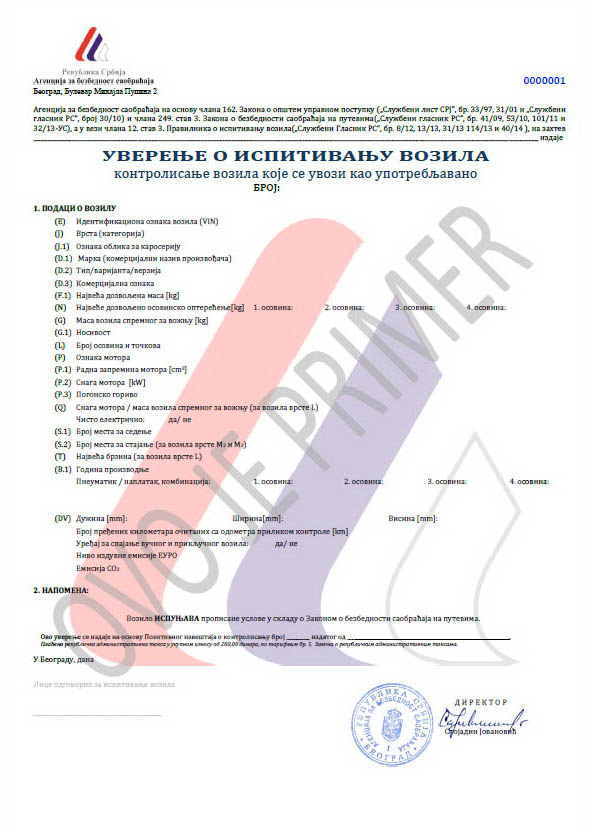
As an exception, for a vehicle imported as used, a certificate will be issued on the basis of a positive test report that does not confirm the vehicle's technical roadworthiness.
The confirmation is valid for five years or until the vehicle's structural characteristics are changed. The confirmation is issued with a shorter validity period in cases where testing determines the need for an earlier inspection.
The testing of motor vehicles and trailers that are individually manufactured and for which no certificate of conformity with the homologation regulations has been issued will be carried out in the manner prescribed by this rulebook from January 1, 2015.
The most common problems on modified vehicles are a rear overhang exceeding the legally permitted 63%, the absence of homologated side protection and rear protection, reversing lights and signaling devices, properly positioned clearance lights, and contour marking tapes for the vehicle..
If a used vehicle has been imported, it may happen that, during the vehicle's inspection, i.e. its check, the chassis, engine or other inspected part numbers do not match in the databases. In that case, the potential buyer or importer will also have to submit a certificate of conformity, or COC (Certificate of conformity). This certificate is issued by manufacturers, their representatives or vehicle distributors in Serbia.
Some of the vehicle distributors we contacted have not yet consolidated their position and do not know how much this certificate will cost, while the more organized ones mention amounts from 6,000 dinars up to 200 euros.
Example of Technical Dimensions
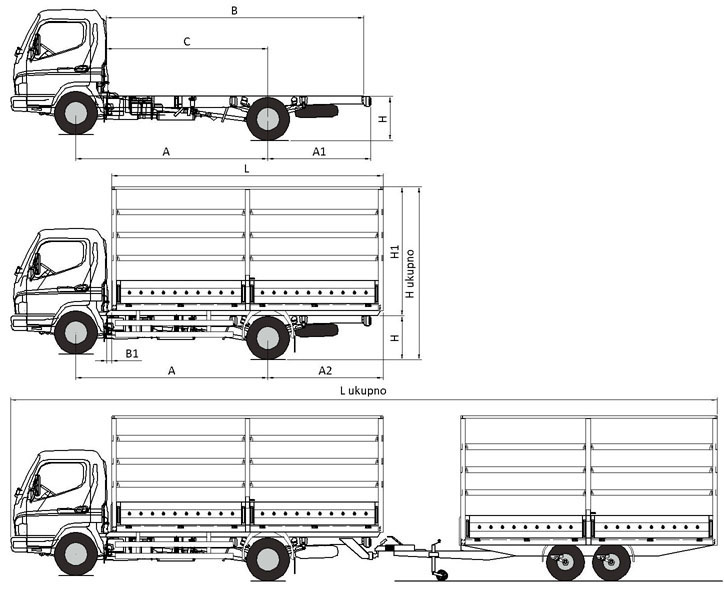
- A – wheelbase
- A1 – rear overhang of the truck
- A2 – rear overhang of the body
- B – distance from the cab to the end of the chassis
- B1 – distance from the cab to the start of the body
- C – distance from the cab to the rear axle centerline
- H – height from the ground to the top of the chassis
- H1 – body height
- L – body length
- L total – length of the vehicle combination, towing vehicle with trailer
- H total – height from the ground to the top of the body
Body Dimensions
Body length L is the length measured from the foremost to the rearmost point of the body:
L = C – B1 + A2
C – distance from the cab to the rear axle centerline – provided by the truck manufacturer (catalog value),
B1 – recommended distance from the cab to the start of the body – most often in the range of 40-100 mm,
A2 – rear overhang of the body – maximum value is 63% of the wheelbase.
Maximum body length L max is the longest body length legally possible for the given vehicle:
L max = C – B1 + 0.63 A
Recommendation when choosing the body length:
50 mm ≤ A2-A1 ≤ 450 mm
A2-A1 > 450 mm the desired body length is possible by extending the chassis and relocating the bumper with the light cluster.
A2-A1 < 50 mm the desired body length is possible by shortening the chassis and relocating the bumper with the light cluster.
Length of the vehicle combination, towing vehicle with trailer – L total: L total ≤ 18.75 m
Body width W is the width measured between the outermost side points of the body. Maximum body width W max is the legally largest possible body width (regardless of vehicle type):
W max = 2550 mm (except for refrigerated vehicles whose side wall thickness exceeds 45 mm, W max = 2600 mm)
Body height H1 is the height measured from the top of the chassis to the top of the body.
Maximum body height H1 max is the height which, together with the height from the ground to the top of the chassis, amounts to 4000 mm:
H1 max = 4000 mm – H